
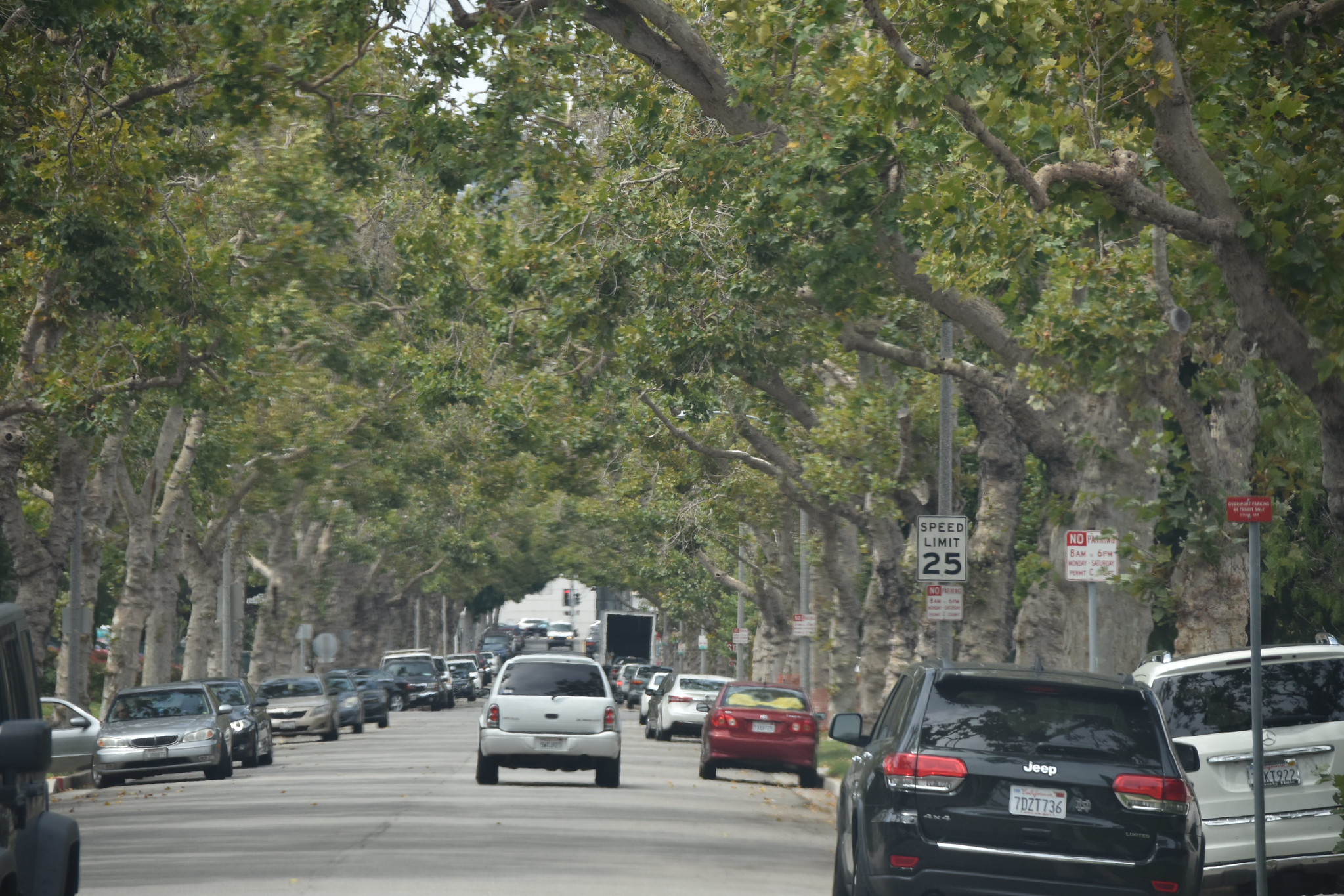
Researchers at the University of Southern California (USC) found that vegetation in a section of central L.A. offsets a surprising 60% of fossil fuel emissions (CO2), particularly during the growing season. The first-of-its-kind study used a dense array of air-quality sensors to track carbon emissions and absorption in real time, providing a more detailed picture than traditional methods. The findings suggest that expanding urban greenery could play a bigger role in reducing the city’s carbon footprint than previously thought.
To track CO₂ in real time, the research team launched what they call the Carbon Census array, deploying 12 sensors across a 15-by-6-mile section of L.A.’s Mid-City. The sensors mapped how CO2 concentrations changed as air moved through the urban landscape, enabling researchers to factor in wind speed and direction and urban density to determine to what extent local greenery was offsetting emissions.
“You can think of emissions like passengers on a train,” said Will Berelson, who led the research and is professor of Earth sciences, environmental studies and spatial sciences at USC Dornsife College of Letters, Arts and Sciences. “As the wind moves pollution through the city, some gets picked up and some gets dropped off. These sensors let us see that process in real time.”
One of the study’s biggest surprises was that trees absorb the most CO₂ during summer, despite it being L.A.’s driest season. Satellite imagery shows L.A.’s urban greenery is remarkably verdant in summer, likely due to irrigation, groundwater access from leaky pipes and resilient tree species.
Still, trees can’t keep pace with emissions. As expected, CO₂ levels spiked during rush hour, reinforcing the fact that, while greenery helps, it can’t offset pollution from cars, buildings and industry on its own.
The study’s findings help inform the USC Urban Trees Initiative, a partnership between USC, the City of Los Angeles and community-based organizations focused on expanding urban greenery in communities that need it most. By identifying where trees absorb the most carbon, the research provides data-driven insights that could help guide future planting efforts.
Photo by Francisco Altunes via Creative Commons CC BY 2.0